
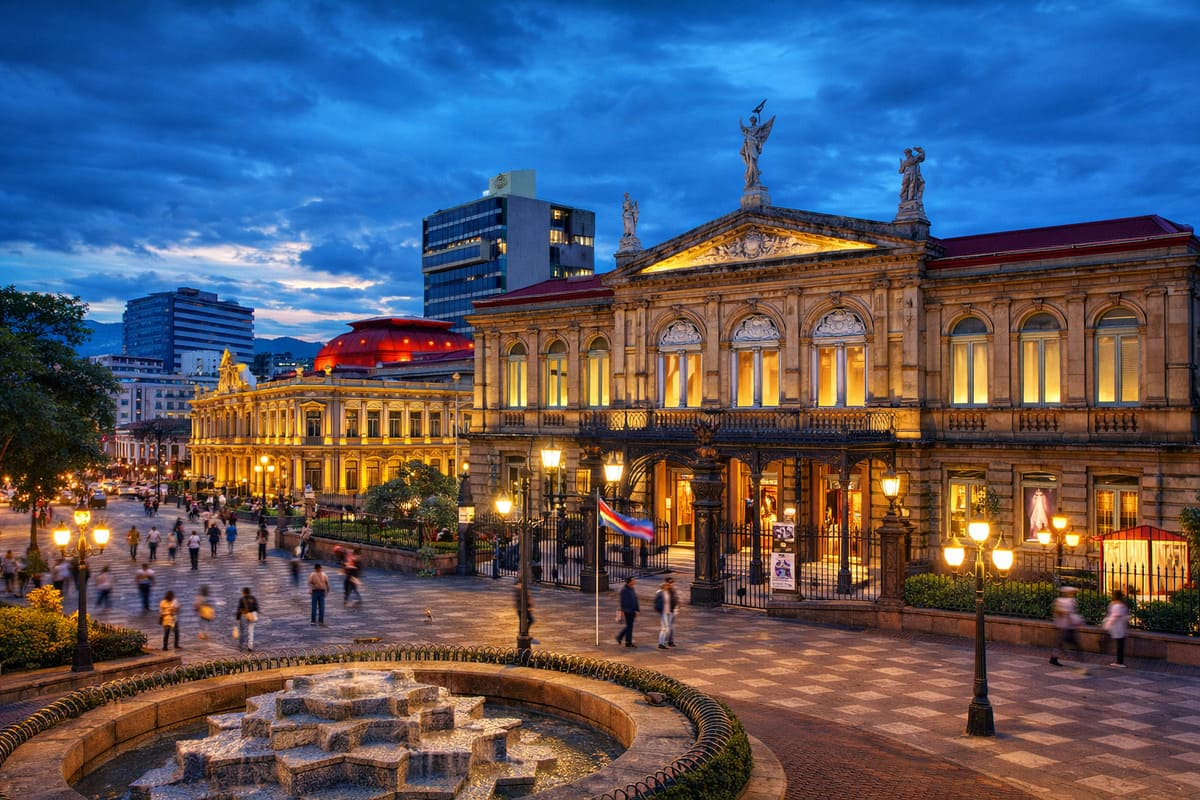
Costa Rica: The Oasis of the World in 2026
Why Does Costa Rica Stand Out in an Unstable World?
In 2026, the world faces an unprecedented convergence of simultaneous pressures: active armed conflicts, tariff wars increasing supply chain costs, Europe’s housing crisis, accumulated inflation in developed economies, and increasingly frequent extreme climate events.
What were once isolated risks have now become a structurally more uncertain global environment.
In this context, Costa Rica does not position itself through size or geopolitical power. It positions itself through balance.
With more than seven decades of democratic stability, regional leadership in peace, strategic trade openness, and one of the cleanest energy matrices in the world, the country offers something increasingly rare: predictability.
Living in Costa Rica in 2026 is not merely an emotional decision. It is a strategic decision grounded in measurable indicators.
Is Costa Rica a Peaceful Country in a World of Active Conflicts?
In 2026, geopolitical stability is no longer guaranteed. Multiple regions remain affected by ongoing armed conflicts and strategic tensions that influence energy markets, trade routes, and international security.
Against that backdrop, Costa Rica presents a measurable structural advantage:
- It abolished its army in 1948 as a permanent constitutional principle.
- It ranks 54th in the Global Peace Index, making it the most peaceful country in Central America.
- In the same index, the United States ranks 128th, highlighting the structural difference in militarization levels.
This is not a tourist perception. It is institutional architecture.
While other economies are affected by global geopolitical tensions, Costa Rica maintains civil stability without involvement in international conflicts.
That is the difference between living in a country shaped by global power struggles and living in one that remains outside of them.
Is Costa Rica a Solid Democracy in a Polarized World?
In 2026, democratic stability can no longer be assumed. Across the Americas and Europe, political polarization and institutional fatigue are increasingly visible.
In that context, Costa Rica offers a clear and measurable advantage:
- It is the oldest and most stable democracy in the Caribbean and Central America, with more than 75 consecutive years of uninterrupted democratic continuity.
- It holds a 91/100 score in global freedom indexes.
- Its electoral system, administered by the Supreme Electoral Tribunal (TSE), is widely regarded as a regional benchmark for institutional integrity.
This is not cultural perception. It is proven institutional permanence.
For a foreign family, it means legal predictability. For an investor, it means regulatory continuity. For a remote professional, it means macro-social stability.
That is the difference between an attractive country and a reliable one.
Is Costa Rica Economically Stable Amid Global Tariff Wars?
Tariff wars have increased global costs and disrupted supply chains. In North America, the estimated impact has exceeded USD 1,300 per household annually, with projected long-term effects on GDP and employment.
In contrast, Costa Rica demonstrates structural advantages:
- 15 Free Trade Agreements providing preferential access to markets representing approximately 75% of the global economy.
- 67 new Foreign Direct Investment projects in 2025.
- Nearly half of new investment originating outside the United States, reflecting diversification.
- Negative inflation at the close of 2025, stabilizing purchasing power.
This is not coincidence. It is economic design.
Costa Rica maintains trade openness and capital attraction in a global environment trending toward protectionism.
Is Costa Rica an Environmental Safe Haven in an Era of Extreme Climate Events?
In 2025, the United States recorded 21 climate disasters exceeding one billion dollars each, totaling approximately USD 115 billion in damages.
- Costa Rica presents a different profile:
- Approximately 99% of its electricity comes from renewable sources.
- Over 25% of its territory is protected under conservation categories.
- A National Biomethane Strategy implemented in 2025.
- More than 12,700 electric vehicles currently in circulation.
This is not green marketing. It is long-term public policy.
While other economies react to climate damage, Costa Rica has built structural resilience.
Is Costa Rica Socially Stable in an Era of Polarization?
In the United States, 85% of the population perceives an increase in politically motivated violence, and 11,679 hate crime incidents were reported in the most recent period. In Germany, hate crimes rose approximately 40% in 2025.
Costa Rica presents measurable differentiation:
- Ranked 7th globally in expatriate satisfaction.
- Approximately 120,000 U.S. citizens currently reside in the country.
- A 91/100 global freedom score supporting civil rights and coexistence.
It is not just the “Pura Vida” slogan. It is sustained social cohesion.
Is Costa Rica a Competitive Healthcare Alternative?
Healthcare costs in the United States remain among the highest globally, while public systems in Canada and Europe face extended waiting times.
Costa Rica offers tangible cost advantages:
- Dental implant: USD 3,500–5,000 in the U.S. vs USD 800–950 in Costa Rica (approximately 75% savings).
- Private medical consultation: USD 200–400 in the U.S. vs USD 50–75 in Costa Rica.
It is not merely about price. It is about competitive cost-quality balance.
Costa Rica combines:
- Universal public healthcare (CCSS).
- Competitive private healthcare network.
- Established medical tourism industry.
The country is also home to the Nicoya Peninsula, internationally recognized as one of the world’s Blue Zones.
Is Costa Rica Financially Sustainable Amid the Global Housing Crisis?
Europe faces structural housing shortages and saturated real estate markets. North America continues to experience pressure on rents and mortgage rates.
Costa Rica offers budget flexibility:
- Lean lifestyle: USD 1,500–1,800 per month.
- Comfortable lifestyle (couple): USD 2,500–3,200.
- Upscale lifestyle (family): USD 4,000–5,000.
Negative inflation recorded in 2025.
It may not be the cheapest destination. It is a destination with real flexibility and choice.
Infrastructure That Supports Growth
Costa Rica has sustained investment in road modernization, airport improvements, and nationwide 5G deployment since 2025.
Urban internet speeds reach up to 240 Mbps.
This is not infrastructure designed for heavy industry. It is infrastructure designed for international connectivity and quality of life.
Why Does Costa Rica Represent an Oasis in a World in Crisis?
The world faces simultaneous structural tensions: conflicts, trade wars, housing crises, rising medical costs, and social polarization.
Costa Rica responds with institutional stability, economic openness, environmental leadership, and social cohesion.
Key indicators include:
- 75+ years of uninterrupted democracy.
- No standing army.
- 15 free trade agreements.
- 67 FDI projects in 2025.
- 99% renewable electricity.
- Up to 80% medical cost savings compared to the U.S.
- Monthly budgets starting at USD 1,500.
- 5G connectivity and expanding infrastructure.
This is not aspirational storytelling. These are verifiable metrics.
In a world attempting to correct structural imbalances, Costa Rica offers balance already integrated into its model.
That is the difference between choosing an attractive destination and choosing a strategically solid country to live in in 2026.